
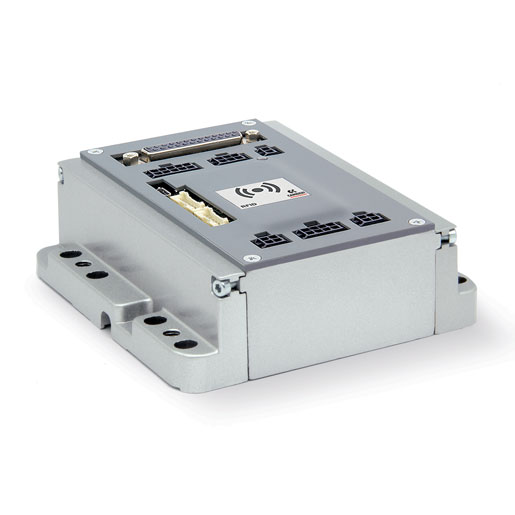
Drives for Stepper motors Series DRCS
One-size full digital drives with WLAN system and NFC integrated
Series DRCS drives, compact and optimised in one size, are capable of controlling all Camozzi Stepper motors with two-phase and micro-stepping feed.
The use of the micro-stepping control technology (up to 1/16 of a step) enables the drive to almost replicate a sinusoidal current while considerably reducing the natural resonance of the motor itself.Series DRCS drives can calculate the normal resonance frequency of the motors and optimise their performance. The availability of eight inputs allows the realisation of a table of 127 commands, for each of which it is possible to set position, speed, acceleration and deceleration.
Each command can be absolute or relative. Through the Step and Direction commands, it is possible to control the drive in frequency mode.
The frequency defines the speed, while the number of steps defines the position.
The Series DRCS drives are equipped with serial protocols CANopen CiA 301 and CiA 402 through which it is possible to perform motion control and condition monitoring of the drive.
To configure the drive, wired USB 2.0 or WLAN connections can be used. Thanks to an innovative system that takes advantage of Near Field Communication (NFC) technology, it is possible to extract production and statistical data on the use of the drive, which are essential parameters for industry 4.0.
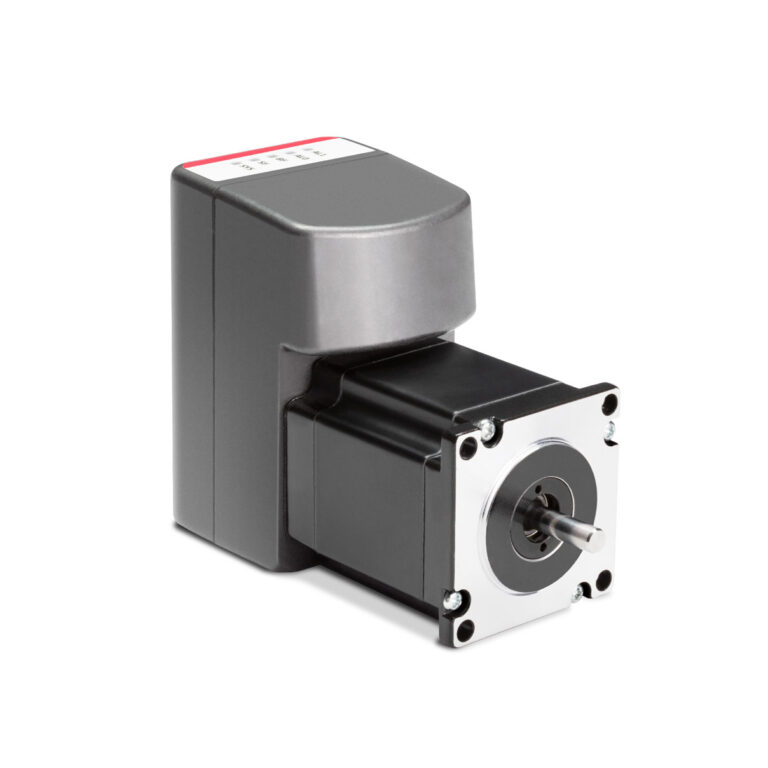
Integrated field-oriented control drive Series DRVI
For stepper and brushless DC, Nema 23 and Nema 24 motors
The Series DRVI integrated motor drive is designed to control various types of motors, both stepper and brushless, using a closedloop control (FOC) algorithm.
This algorithm, also known as vector control (FOC), offers better performance than traditional stepper motor control systems, which allows the stepper motor to operate over the entire speed range, ensuring fast acceleration and deceleration, assuring more accurate motion control with no loss of steps.It is also more energy efficient than traditional control methods, as it uses precise rotor position feedback and controls the phase current, optimising motor operation.
Its compact design and integration with the main communication protocols make the Series DRVI the ideal solution for various industrial applications that require accurate control and fast response to load variations.