
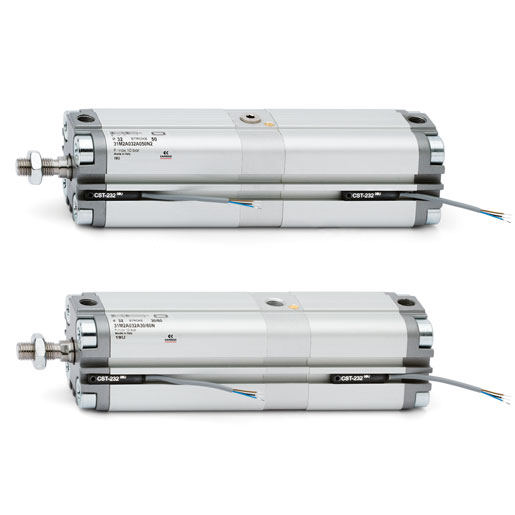
Compact cylinders, Tandem and Multi-position versions Series 31
Double-acting, magnetic
Ø 12, 16, 20, 25, 32, 40, 50, 63, 80, 100 mm
The compact dimensions allow Series 31 cylinders to be installed within very small spaces. These cylinders are suitable for use with feet, flange and trunnion mountings.
In order to complete the compact cylinder series, two new versions have been introduced: tandem and multi-position. The new Tandem version with 2, 3 or 4 stages generates a thrust force which is 2, 3 or 4 times that of the normal cylinder (standard traction force).
The Multi-position version allows a maximum of 3 different positions which are determined by the stroke of the individual actuators.
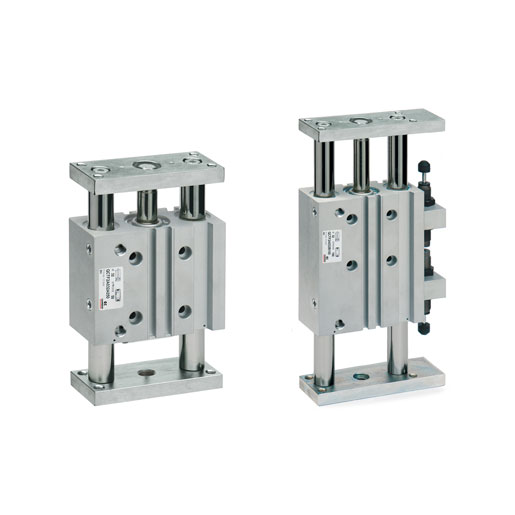
Cylinders with integrated guide Series QCTF – QCBF
Double-acting, magnetic, with double bearings and flanges
Ø 20, 25, 32, 40 mm
These cylinders have been designed to be used in applications where space is limited.
Regarding the bearings, the Slide Units are available in two versions, one with double sintered bronze bushes (Mod. QCTF) and the other with double linear ball bearings (Mod. QCBF).
The QCTF version would normally be selected when the side loads applied to the slide unit are high. Mod. QCBF is suitable for fast cycles (less side load) and higher precision.
The end cushioning is available in three different variants:
- Fixed mechanical cushion (standard);
- With two shock absorbers located on the body;
- With one shock absorber located central on the rear flange.
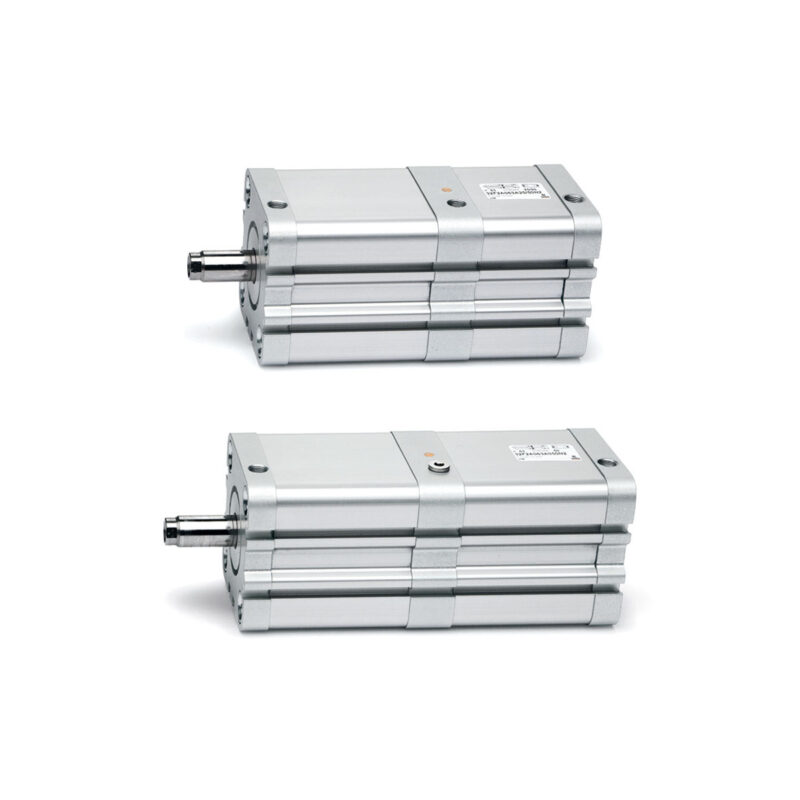
Series 32 compact cylinders, Tandem and Multi-position versions
Double-acting, magnetic
ø 25, 40, 63, 100 mm
Thanks to their great compactness Series 32 cylinders, Tandem and Multi-position, are suitable to be installed within confined spaces and can be used with the same mounting elements of other standard cylinders ISO15552.
The Tandem version enables to obtain up to 2 times the thrust force of a normal cylinder (standard traction force), while the Multi-position version can obtain up to three positions with one cylinder only.
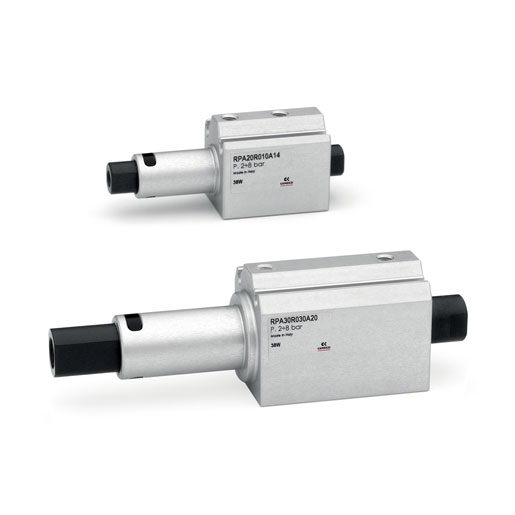
Short-stroke cylinders Series RPA
Double-effect, magnetic
With hollow through rod and mounting stud
Bores: 20 and 30 mm
The Series RPA short stroke cylinders are double acting actuators with aluminium hollow through rod and mounting stud. Available in two sizes, Ø 20 and Ø 30 mm, with different strokes and dimensions of the mounting stud, these actuators are equipped with the non-rotating function of the rod.
The Series RPA are prepared for the mounting of magnetic sensors (Series CSD), in fact, on the external profile, along the cylinder tube, you can find sensor positioning slots.
Their compact and light design together with the adopted technical solutions make these cylinders suitable to be used, combined with suction pads, in End Of Arm Tooling (EOAT) systems, especially in the sector of plastic injection moulding.
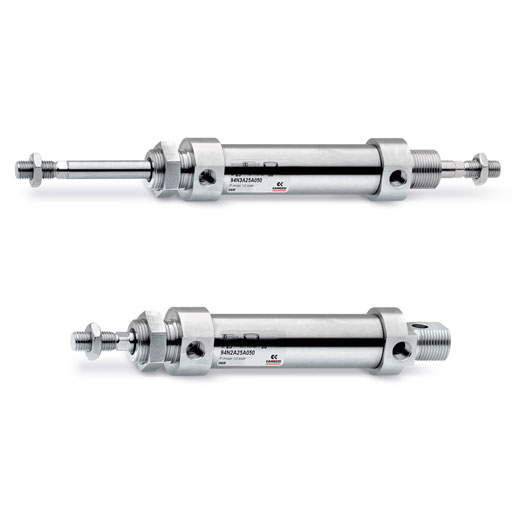
Stainless steel mini-cylinders Series 94 and 95
Single-acting and double-acting, magnetic
Series 94: ø 16, 20, 25 mm
Series 95: ø 25 mm, cushioned
The Series 94 and 95 cylinders can be used in critical applications in which a high corrosion resistance is required (for example off-shore, marine, food).
Their construction enables the replacement of all seals.
Series 95 is normally equipped with adjustable end-stroke cushioning by means of a screw on the end block.
In addition both Series 94 and 95 are equipped with a mechanical cushioning in order to make the impact of the piston less noisy as it reaches the end of the stroke.