

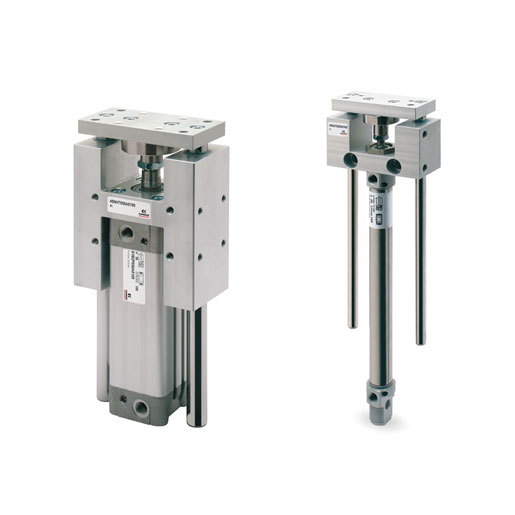
Anti-rotation guide units Series 45
Suitable for cylinders:
- DIN/ISO 6432 (Ø 12, 16, 20, 25 mm)
- ISO 15552, previous DIN/ISO 6431 (Ø 32, 40, 50, 63, 80, 100 mm)
Series 45 guide units can be used with all DIN/ISO 6432 cylinders of Ø 12 ÷ Ø 25 and ISO 15552, previous DIN/ISO 6431, cylinders of Ø 32 ÷ Ø 100.
They have been developed in order to prevent piston rod rotation and can support possible radial loads.
Series 45 guide units are available in three different models depending on the applicable loads.
The UT and HT guides with crawling supports are self lubricating, while HB guides have a ball bush.
To ensure the right choice of the loads in relation to the stroke, please refer to the graphs.
The shorter the stroke the higher will be the applicable loads.
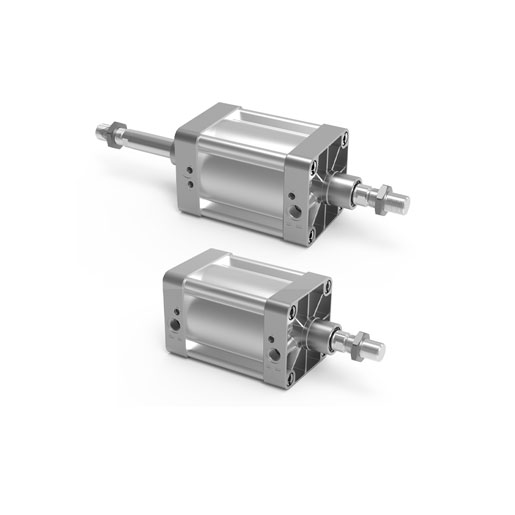
Cylinders aluminium profile Series 41K
Double-acting, cushioned, magnetic Ø 160 - 200 mm
Series 41K cylinder comply with the ISO 15552 standard and can be assembled with the entire range of standard accessories.
The mounting brackets used on the end-blocks tube are designed in an extremely secure way, making use of cylinder tie-rods positioned internally and not visible on the assembled cylinder.
This cylinder series is normally equipped with adjustable endstroke cushioning by means of a screw positioned on the end-block.
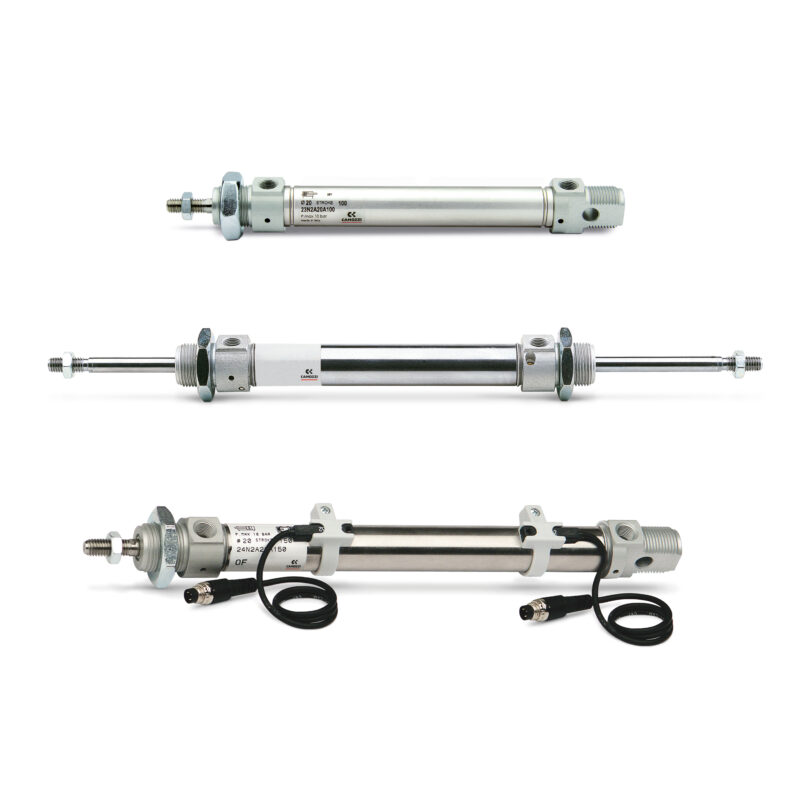
Series 16, 23, 24 and 25
Series 16: Ø 8, 10, 12 mm - non-magnetic
Series 23: Ø 16, 20, 25 mm - magnetic, auto-cushioned
Series 24: Ø 10, 12, 16, 20, 25, 32 mm - magnetic
Series 25: Ø 16, 20, 25, 32 mm - magnetic, cushioned
Series 16, 23, 24 and 25 mini-cylinders are designed according to ISO 6432. It is possible to choose from three different types of cushioning: mechanical (standard bumper on Series 16 and 24), adjustable pneumatic cushioning (Series 25) and pneumatic auto-cushioning (Series 23).
This last version, thanks to a patented system, automatically adjusts the cushioning in order to provide optimal deceleration during the entire cushioning phase.
The cylinder enjoys smooth, jolt-free movement, reducing vibrations and noise, while also guaranteeing high reliability and constant performance over time.
The adopted technical solutions and the choice of materials have provided the basis for a complete range of versatile and very reliable mini-cylinders.
They are suitable to be used in a multitude of industrial applications, especially where operating conditions undergo changes over time like for example wear of machine components.
Various mounting accessories are available to fix the cylinders in different ways.
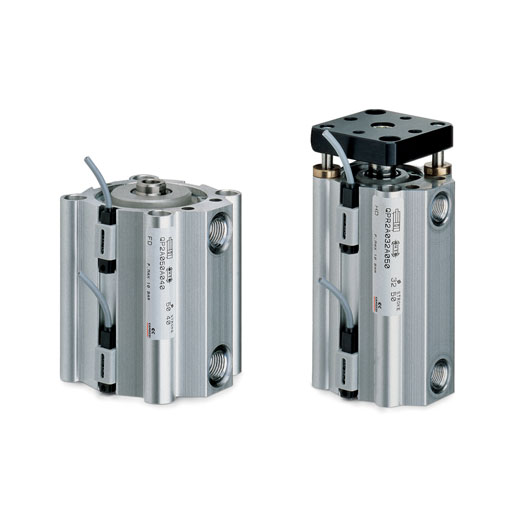
Short-stroke cylinders Series QP – QPR
Series QP: single and double-acting, magnetic
Series QPR: double-acting magnetic, non-rotating
Ø 12, 16, 20, 25, 32, 40, 50, 63, 80, 100 mm
Series QP - QPR cylinders are available in 10 bore sizes, from Ø 12 to Ø 100.
Their compact dimension allows the installation in small spaces.
Because of their particular construction, they can be mounted by means of feet or trunnion.
The guides are manufactured in the external profile parallel to the sliding axis on three sides.
These are used to locate the switches that sense the piston position.
The non rotating guides make the QPR suitable for supply operations and for handling equipment.
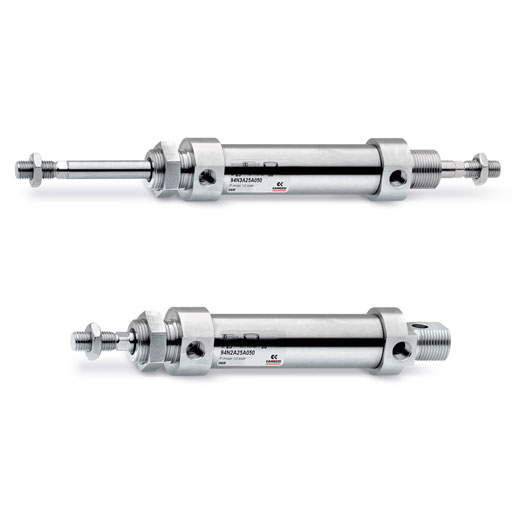
Stainless steel mini-cylinders Series 94 and 95
Single-acting and double-acting, magnetic
Series 94: ø 16, 20, 25 mm
Series 95: ø 25 mm, cushioned
The Series 94 and 95 cylinders can be used in critical applications in which a high corrosion resistance is required (for example off-shore, marine, food).
Their construction enables the replacement of all seals.
Series 95 is normally equipped with adjustable end-stroke cushioning by means of a screw on the end block.
In addition both Series 94 and 95 are equipped with a mechanical cushioning in order to make the impact of the piston less noisy as it reaches the end of the stroke.